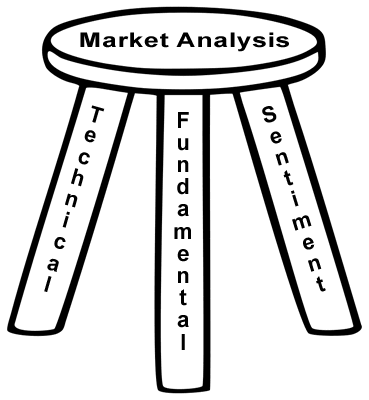
Aha,The million dollar issue in yourforeign exchangeOn your investment journey, you will encounter traders who advocate how good a certain analytical method is. Don't be fooled by these extremist extremists who lean towards one side. In foreign exchange analysis, there is no better method than another, they are all different methods of analyzing the market. I dare not use any particular analysis method, you should find the most suitable one that can make you stable and profitable. Let's review that technical analysis is a method of studying price trends through graphics, while fundamental analysis mainly studies the economic fundamentals of a country. The market sentiment analysis method is used to determine whether the market is in a bull or bear market based on current or future fundamental prospects. Fundamental factors can form market sentiment, and technical analysis helps us visualize this sentiment and provide a framework for our trading. The three analytical methods are interrelated and can help you make the best trading strategy. All the historical price fluctuations and economic data are there, all you need to do is use these analytical techniques to test your trading system. Removing any two feet from the stool will make it unstable.
In order to become a true selfForeign exchange transactionsMaster, you need to know how to effectively utilize the above three analysis methods. Don't believe us? Let us give you an example that will tell us that focusing solely on one analytical method can be a disaster. ★ If you are observing your technical chart and you see a good trading opportunity. You become quite excited because money will rain down from the sky. You say to yourself, 'I have never seen pounds.'/The US dollar presents such a perfect trading opportunity. I love my technical graphics. Now, let the money roll in! ” ★ With an exaggerated smile, you immediately bought pounds/Dollar, all your teeth exposed are enough to show your current mood ★ But wait a minute. Suddenly, the market fluctuated in the opposite direction100Point. A major bank from London declared bankruptcy, and you were completely unprepared for it. In an instant, everyone's mood towards the London market became low, and everyone immediately engaged in reverse trading. ★ You went from joy to sadness in an instant, and were filled with anger towards your figure. You smashed your computer to the ground, wishing you could crush it to pieces. You just lost a banknote, and now your computer has become an innocent victim. This is all because you completely ignored fundamental analysis and sentiment analysis. (Note: This is not based on a true story. This situation has not occurred in our daily lives. We have never been so naive. We have always been shrewd traders...From this ironic extreme example, we believe you have understood the essence behind it.) Okay, although this example has a bit of elaboration, you already know the importance of comprehensive analysis. Remember what our mother told us when we were young - eating too much of one thing is never a good thing for children. You may think that what we are saying is just nonsense, but when it comes to the foreign exchange market, this statement also applies. Don't rely solely on one analytical method. On the contrary, you must learn to use all three analytical methods in a balanced manner. Only in this way can you maximize your chances of successful trading. What are we going to learn next?Where do we go from here?Now that you have a general understanding of each analytical method, it is time for you to delve deeper into it. The primary school curriculum will teach basic technical analysis tools. In this series of courses, you will learn about support and resistance levels, candle shapes, and common technical forms. You will also be exposed to leading and lagging indicators and learn how to use these indicators to assist your trading. It sounds very exciting, doesn't it? The middle and high school curriculum will be dedicated to learning more technical analysis tools. We will learn more advanced analytical tools in this series of courses, such as pivot points, divergence, Elliott wave theory, and Galilean forms. I guess you can't wait to learn these courses, can you? University courses will be more complex as you will learn both fundamental analysis and market sentiment analysis simultaneously. The reason why we combine fundamental analysis with market sentiment analysis is that: ★ Once you enter the university stage of study, your willingness to study foreign exchange will be stronger, and courses that are too simple will not be enough to meet your needs ★ We find it difficult to distinguish between fundamental analysis and market sentiment analysis. As we mentioned before, fundamental factors can shape market sentiment. We will learn these two analytical methods in our freshman and sophomore years. |


MIP|Mobile version|A small dark room| |Site Map |customer serviceQQ:2381682638
Copyright © 2006-2024 Huiyi Interaction https://www.forexbbs.net copyright All Rights Reserved.